Summary:
UCLA researchers in the Departments of Electrical and Computer Engineering and Bioengineering have developed a deep-learning-enhanced multiplexed optical biosensing platform that enables rapid, high sensitivity point-of-care quantification of multiple cardiac biomarkers for cardiovascular diagnostics.
Background:
Rapid and accessible cardiac biomarker testing is essential for timely diagnosis and risk assessment of myocardial infarction and heart failure, which together account for more than one-third of cardiovascular mortality worldwide. Despite their severity, current laboratory and point-of-care testing systems remain limited by long turnaround times, narrow dynamic ranges, and single-analyte formats that fail to capture the complexity of cardiovascular disease. Conventional benchtop analyzers typically require separate cartridges, specialized reagents, and relatively large blood volumes, often producing results only after several hours. Point-of-care testing offers improved accessibility but still faces challenges including limited sensitivity for key biomarkers such as cardiac troponin, restricted multiplexing capability, and instrument formats that remain relatively bulky rather than handheld. These limitations in the current state of the art hinder effective early detection of cardiac disease, ultimately increasing the burden on healthcare systems. Thus, there remains an unmet need for a cost-effective and simplified platform capable of rapid, multiplexed, and highly sensitive point-of-care diagnostics for cardiovascular diseases.
Innovation:
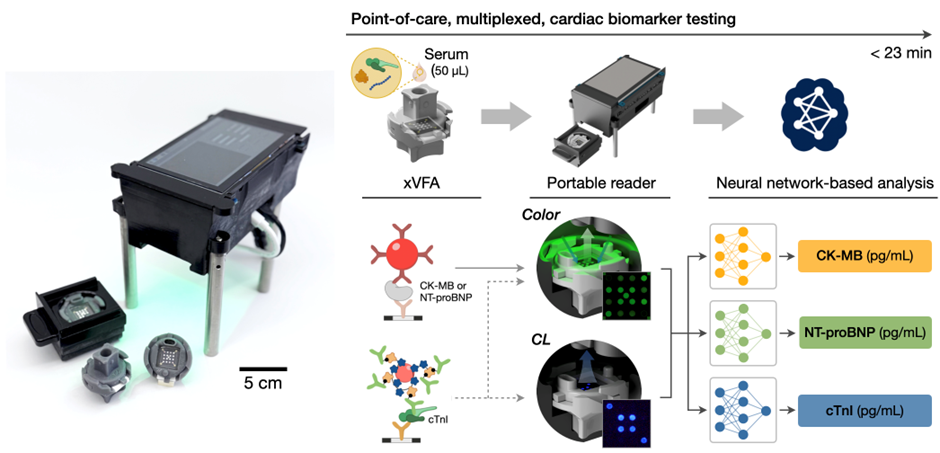
To address these limitations, Professor Aydogan Ozcan and his research team have developed a novel deep-learning-enhanced dual-mode multiplexed vertical flow array (xVFA). This device is integrated with a portable optical reader and a neural network-based quantification pipeline. The system achieves a dynamic detection range spanning approximately six orders of magnitude, enabling simultaneous measurement of both low- and high-abundance cardiac biomarkers with sub-pg/mL to sub-ng/mL sensitivity. The platform provides rapid assay turnaround (~23 minutes) while maintaining high quantitative accuracy through automated neural network–based signal analysis. By combining high sensitivity, multiplexing capability, and automated data processing within a compact and cost-effective optical sensor architecture, the dual-mode xVFA enables fast and reliable cardiovascular diagnostics at the point of care. The system simultaneously quantifies multiple biomarkers within a single disposable cartridge, and experimental validation demonstrates that multiplexed detection of key cardiac markers does not compromise analytical specificity. This architecture significantly advances point-of-care diagnostics by enabling comprehensive and scalable cardiovascular biomarker analysis in diverse healthcare environments including hospitals, emergency departments, community clinics, and long-term care facilities.
Short summary:
A dual-mode vertical flow assay integrates colorimetric and chemiluminescent sensing modalities, a portable reader, and neural network analysis for rapid, multiplexed detection of cardiac biomarkers at the point of care.
Potential Applications:
● Point-of-care cardiovascular diagnostics
● Myocardial infarction detection and triage
● Heart failure risk stratification
● Treatment monitoring and prognosis assessment
● Multiplexed biomarker testing in decentralized and emerging healthcare settings
● Congenital disease detection and monitoring
Advantages:
● Multiplexed detection of multiple cardiac biomarkers in a single assay
○ Creatine Kinase-MB (CK-MB)
○ Cardiac Troponin I (cTnI)
○ N-terminal pro-B-type natriuretic peptide (NT-proBNP)
● Six-order-of-magnitude dynamic detection range
● Sub-pg/mL to sub-ng/mL analytical sensitivity
● Rapid turnaround with automated neural-network analysis
● Compact and portable point-of-care platform for rural or emerging environments
● Reduced reagent consumption and simplified workflow
Status of Development:
First successful demonstration March 2025
Related Technologies and Publications:
- Deep Learning-Enhanced Chemiluminescence Vertical Flow Assay for High-Sensitivity Cardiac Troponin I Testing (Case No. 2025-128)
- Han, G.-R.; Goncharov, A.; Eryilmaz, M.; Joung, H.-A.; Ghosh, R.; Yim, G.; Chang, N.; Kim, M.; Ngo, K.; Veszpremi, M.; Liao, K.; Garner, O. B.; Di Carlo, D.; Ozcan, A. Deep Learning-Enhanced Paper-Based Vertical Flow Assay for High-Sensitivity Troponin Detection Using Nanoparticle Amplification. ACS Nano 2024, 18, 27933–27948. https://arxiv.org/pdf/2402.11195
- Deep Learning-Enhanced Paper-Based Vertical Flow Assay for High-Sensitivity Troponin Detection Using Nanoparticle Amplification (Case No. 2024-179)
Reference:
UCLA Case No. 2026-178
Lead Inventors:
Aydogan Ozcan, Chancellor’s Professor, Department of Electrical and Computer Engineering and Bioengineering; Dino Di Carlo, Bioengineering Department Chair